The State of Agentic Engineering 2026: AI moved the bottleneck, and teams kept the same rituals


Between 15 September and 2 October 2026, 52 development teams told us how they plan and build software. Most work at large organisations: 65% at companies with more than 1,000 people, and 60% of respondents are software engineers. Read this as a picture of enterprise teams.
We think AI multiplies whatever system it lands in, which means a team's agility decides how much it gets back from AI. Teams that learn together every sprint will learn faster with agents, while teams running agile theatre will produce more output and run into the same problems sooner.
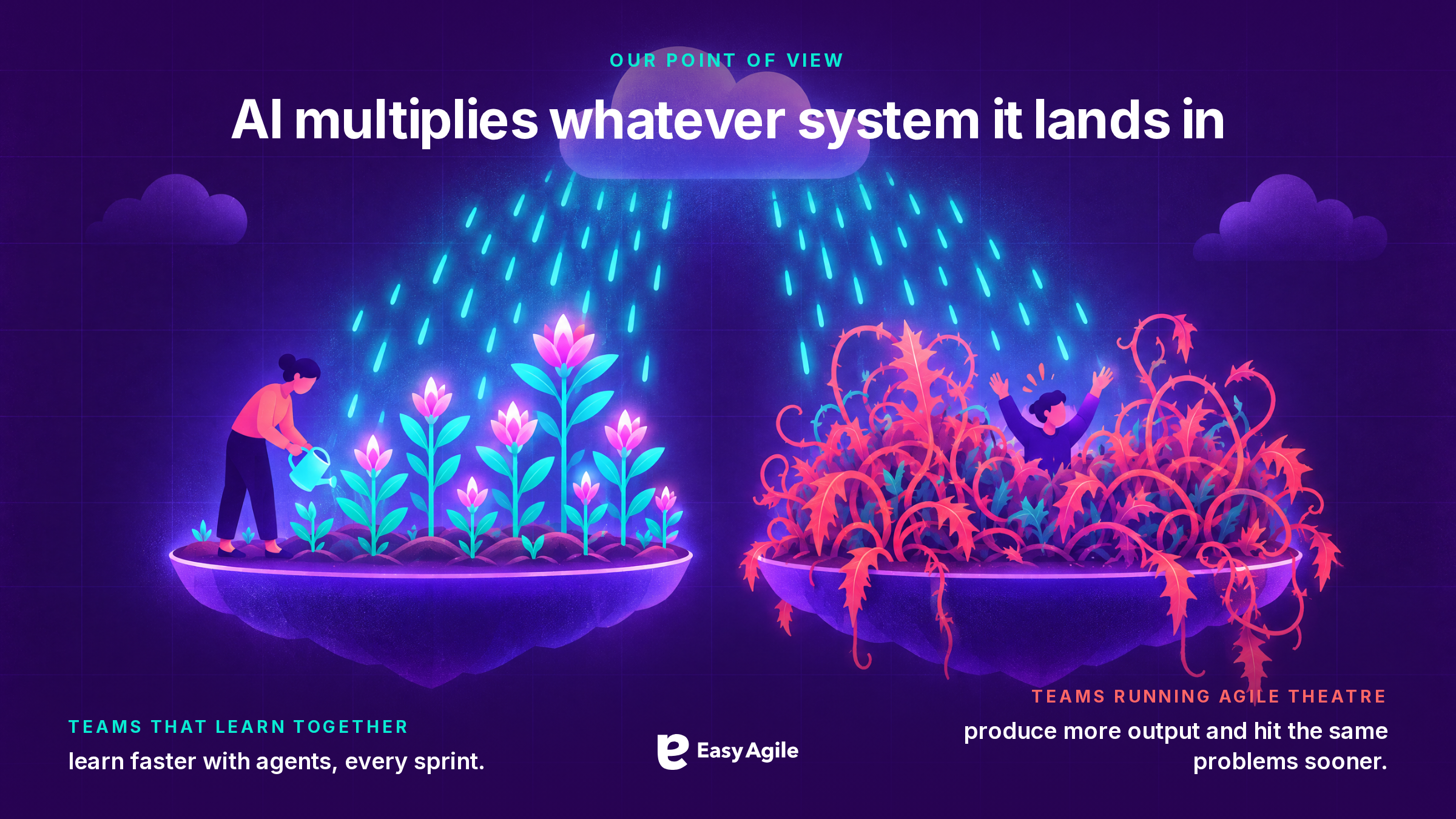
Three things stood out to us across the results. The bottleneck has moved to code review, because writing code got cheaper while AI added downstream work most teams don't count yet. Teams changed how they build but left their standups and sprint cadence alone. Cross-team planning already hurts for a third of teams, and agents are likely to make that worse.
1. Most teams use AI assistants daily, and half expect to run agents within a year
69% of teams use AI coding assistants daily across the team, and 2% use no AI. 17% run agents today, and 52% expect to within 12 months. Of the teams on daily assistants, 58% expect to make that jump within a year.
Our take: if teams follow through, three times as many will run agents next year, and the problems in the rest of this report will grow with them.
2. Engineers spend their days reviewing
67% say a quarter or more of their shipped code comes from AI, and 41% put it at half or more. 59% now spend more time reviewing work than writing it, and 43% carry more parallel work in progress than they did six months ago.
"Code is generally more unreadable and PRs are too big to actually review. AI tends to reinvent the wheel every time it's used. It makes a mess very fast." Engineer, 1,001–10,000 person company
Our take: this is the multiplier at work. In a team with tight feedback loops, faster code means faster learning. In a team without them, it means a longer review queue and more rework, and most teams leave that cost out when they tally their AI gains.
What happened to us. Our first push with AI made us faster until the work piled up at the pull request, and we spent more time reviewing than we had saved writing. We turned inward: we've been levelling up our codebases, consolidating into monorepos and making our conventions consistent, so we can trust agent output before it reaches review. Other teams tell us the same, and Atlassian's State of AI SDLC summit in September ran a session titled "Your Agent Is Only as Good as Its Context". Agents write better code when your codebase gives them consistent patterns to copy.
3. The ceremonies are on autopilot
Only 10% of teams changed their standups, and 10% changed their sprint cadence. A quarter say story points matter less or they dropped them, the biggest ceremony-level shift. 14% plan across teams differently.
Our take: teams changed how they build and kept running their rituals on habit. A ritual on autopilot is agile theatre, and AI speeds up the theatre along with the work. Ask of each ceremony on your calendar whether it still helps your team learn and decide together, and change the ones that don't.
4. AI drafts the specs
AI helps write stories and specs for 69% of teams. In 37% of teams, AI writes the first draft and a human edits it. 16% still write every story by hand. Respondents told us about rework and "text bloating in stories, tasks and sub-tasks."
Our take: AI can write the words, and only your team can agree what it's building and why. Shared understanding is the part of agility that AI can't do for you, and it's worth protecting as drafting gets cheaper.
5. Cross-team planning hurts for a third of teams
We asked teams that coordinate across teams to rate the pain from 1 to 5. The average was 3.0. 30% rated it a 4 or 5, and 28% rated it a 1 or 2. Companies with more than 10,000 people averaged 3.24; everyone else averaged 2.84.
Our take: agents will make this bigger. Each agent adds work in flight and hand-offs between teams, so coordination load rises with output even when headcount stays flat. If you lead a large engineering organisation, ask your engineers how much of their week goes on waiting for another team.
6. Security shapes tool choice
63% say security, compliance or data residency has blocked, delayed or narrowed their AI tooling. The top three things that make approval easier: the tool comes from a vendor they already contract with (31%), it sits on a marketplace they already buy through (29%), or their data stays inside tools they already run (29%).
Two bets for 2027
- We expect retros to become evidence-led. Agents will gather patterns before the meeting, such as rework and actions that never got done, so the team can spend the hour on why. One agile coach in our survey asked for this: "actionable evidence (proof) based examples so that the team can do better RCA."
- We also expect coordination to start biting. As agents add work in flight, cross-team dependencies will cause more delay than any single team's speed, starting at large organisations.
We'll test both in next year's survey. Over the next four weeks we'll go deeper on one finding at a time.
Method: we screened out non-development teams, leaving 52 usable responses collected between 15 September and 2 October 2026. Percentages are of respondents who saw each question. We corrected quotes for spelling only and attribute them by role and company size.

Related Articles
 Company
An agile renaissance: why agentic engineering means the fundamentals matter more
There's a version of the current moment that goes something like this: AI writes the code now, so the ceremonies and the cadences and the careful slicing of work were scaffolding for a slower era, and we can quietly let them go.
We've spent the past year adopting LLMs inside our company. We have experimented with agentic engineering, LLMs pouring over research to identify patterns, leveraging design systems and AI for prototypes, exploring how we can reduce the turns on customer support, and a whole lot more. What we have found is that the tried and trusted agile practices haven't become less relevant. They've become the thing holding everything together.
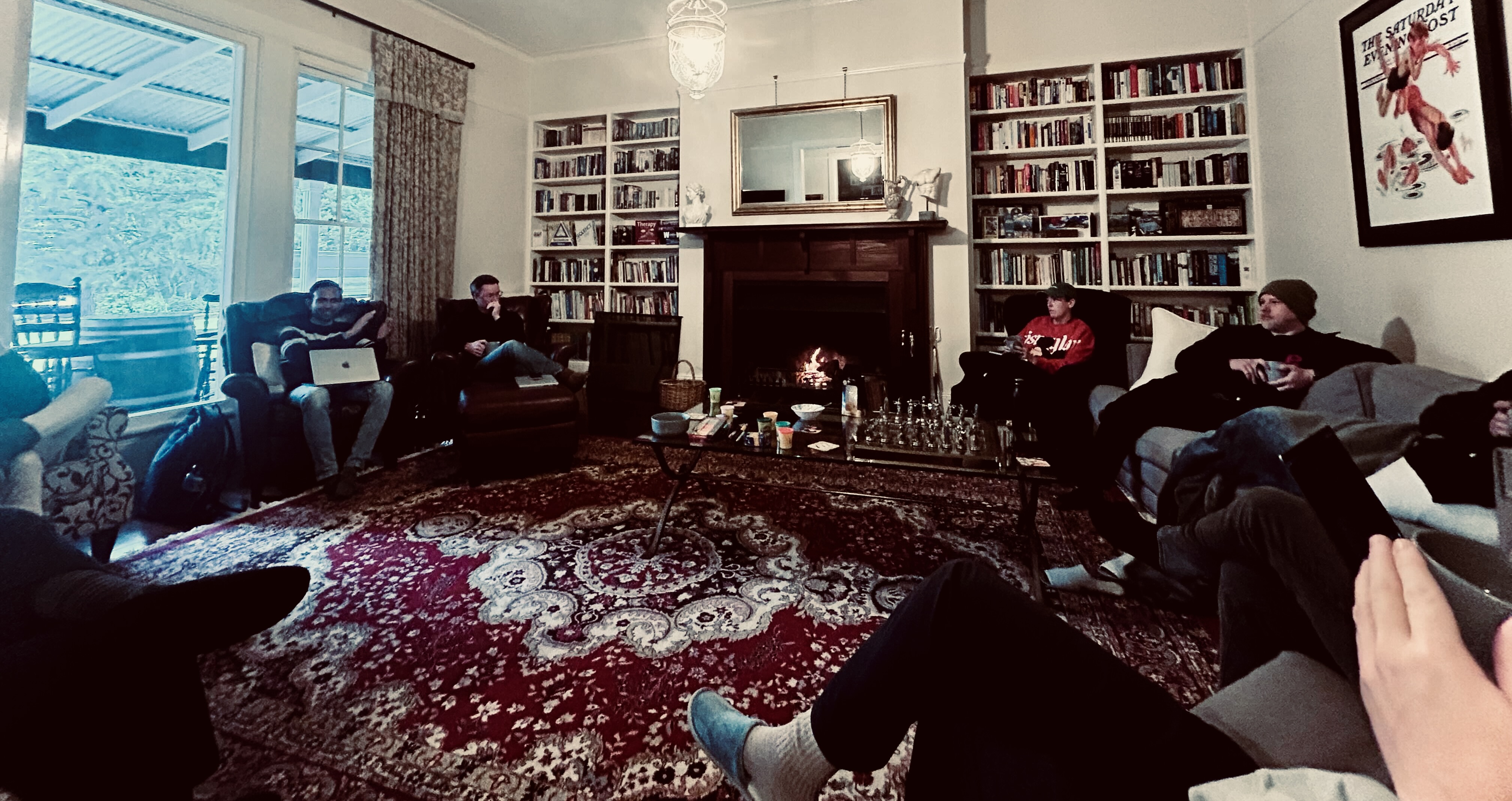
Last week at our in person team get together, which we call Advance Easy Agile, we started calling this the agile renaissance.
The bottleneck moved. It didn't disappear
The most useful lesson we've learned is also the least glamorous.
When your team can suddenly produce X3 as much work in progress, the constraint doesn't vanish, it simply moves. Code generation stops being the bottleneck and review becomes one. Or testing. Or deployment. Or the single person who understands the integration well enough to say whether the change is safe.
The failure mode is subtle and it feels like productivity. You start more work because there's capacity to start it. Everything is in flight, nothing is in production, and the queue in front of your slowest step keeps growing. You've optimised one part of the value stream and yet made the whole system worse.
Lean principles were written for exactly this. Limit work in progress. Optimise the whole system, not the part you happen to be looking at. Find the constraint before you add throughput upstream of it.
A key reminder for our team as we experiment with agentic engineering: don't start more work just because the LLM has capacity. Shepherd what's already in flight through to production first.
Small slices got more important, not less
The instinct with a capable model is to hand it a bigger problem. A whole feature. A whole epic. It will happily oblige, and you'll get a large volume of plausible output that may be time consuming to verify and painful to unpick when one assumption at the base of it turns out to be wrong.
Small, thin, independently valuable slices give you something a large batch can't: fast feedback on whether you're building the right thing, and a cheap way to change your mind. That was true when a human wrote every line. It's more true when generation is fast and verification is the slow part, because the cost of a wrong direction now lands almost entirely on review.
Decomposition and just enough upfront planning for the LLM loop may become one of the highest-leverage skills on a team in 2027. Breaking a piece of work into pieces that flow through the system - that are composable, that each stand on their own, that can be checked in isolation, behind a feature flag - is the thing that lets the team go fast safely and in the right direction, rather than just fast.
Retrospectives make space to improve
Here's the pattern we didn't anticipate.
The more time people spend working with an LLM, the more their working day becomes a solo activity. It's a conversation, and a productive one, and yet it happens in a window on one person's screen. The incidental collaboration that used to form part of the regular work day - chatting to the person next to you, conducting an over the shoulder review of some WIP, or just overhearing a conversation that changes your approach - appears to have been thinning out for our team without a conscious decision being made.
So the deliberate moments carry more weight than they used to. Planning is where a team builds genuine shared context rather than parallel individual understandings of the same work. Retrospectives are where a team notices that its process has drifted, that a new tool introduced a new failure mode, that the way work moves through the system stopped matching the way it's described.
A retrospective was always the mechanism for a team to adapt, course correct and improve. Teams are adapting faster than they have in years. Skipping the ceremony that processes that change, right now, is poor timing.
Talk about the outcome, not the technology
One more (and perhaps the most important thing), and it applies as much to how we build our own products as to anything else.
Nobody really wanted AI per se. Companies sought predictable outcomes, customers wanted tangible value more quickly, and team members wanted engaging work and more time with their families and friends. There's a lot of software shipping right now with an AI feature bolted on, and folks can tell. It doesn't take long to work out which capabilities were built to solve a real customer problem and which were built to be mentioned.
Can we describe the value we are delivering without naming the technology underneath it? For example, can they plan more effectively? Are they able to spot a bottleneck sooner? Will they walk out of a retrospective with an action item that will improve how they work? That is what we need to be championing. How it works underneath is an implementation detail, and framing it as the headline usually means the outcome underneath isn't strong enough to lead with.
A constant reminder from our colleague Teagan last week - look at this from the perspective of our customers. We get caught up in the excitement too, yet we need to stay grounded in what our customers need.
A renaissance implies something went wrong first.
If you spend any time in this space, you'll have seen the other framing: agile is dead. It's said with a lot of feeling at the moment, and I don't think the feeling is unearned.
Somewhere over the past two decades, the four values in the manifesto got industrialised. A set of principles about how people work together became a thing you buy, roll out and report on. For plenty of teams, "agile" now names something that was done to them rather than the way they work. A multi-year transformation, a re-org, new titles, a wall of velocity charts, and a stand-up that quietly became the status report to a manager. Ceremonies observed. Principles nowhere. If that's the association, "agile is dead" seems like a fair thing to say.
That's not what we're proposing a renaissance of. Nearly the opposite, in fact. The practices holding up under agentic engineering are the small, load-bearing ones: limit work in progress, slice thin, get feedback early, inspect and adapt together. None of that needs a transformation program or a maturity assessment. A team can start on Monday, on their own team, without permission.
I should be upfront abut where we sit in all this: Easy Agile has built a business on the industrialisation, and we exist to help teams live the principles at scale, in service of better outcomes for their own customers. The need is real - the manifesto was written about small teams who could see each other, not four hundred people across 11 timezones. The failure wasn't scaling the principles, it's that the apparatus became the deliverable while the feedback it was meant to produce went missing.
Where to from here?
It was great to come together as a team at Advance Easy Agile and reflect on the current state of the market, reflect on what we've learned within the product & engineering space over the past 25 years with the adoption of agile practices and lean principles. I think back to my first workshop with Mary Poppendieck in 2009 and how much we've learned and evolved in the software space since then. And then I think of how much we have to re-learn, how everything old is new again.
If you're navigating this with your own team, the least risky place to begin isn't a tooling decision. "Individuals and interactions over processes and tools".
What are you going to do? Perhaps start by looking at where work is piling up in the system and have a conversation with the team about it in a retrospective. Some conversation starters: what is genuinely faster? what has quietly become the new constraint? what is in progress right now that nobody is shepherding to done? Finish what you've started before pulling in more work.
None of this is new. And that's the point. We're an early adopter of agentic engineering practices and we are working with mid-market and enterprise teams who are starting to explore AI. We're surely going to be having these same conversations again and again over the next couple of years. The practices we see holding up best under the current changes are the ones agile and lean thinking gave us decades ago. The tools are new. The discipline isn't.
If you want to chat about this feel free to find some time on my calendar.
Easy Agile builds Jira-native apps that help teams plan, prioritise and improve together — including TeamRhythm for user story mapping and retrospectives, and Programs for PI planning across teams.
 Workflow
Why Team Planning Will Feel Harder Than It Should in 2026 (and What To Do About It)
TL;DR
Sprint planning feels harder because distributed/async work, tool consolidation, and Atlassian AI expose priority noise, software estimation problems, and hidden dependencies. This guide shares three team planning best practices - set a clear order of work, estimate together to surface risk, and close the loop with action-driven retrospectives, so team alignment and team collaboration improve and plans hold up.
---
Sprint planning should not feel like a shouting match where the loudest voice wins. Yet for many teams it has become a long meeting that drains energy, creates a weak plan, and falls apart by Wednesday.
The problem is not that your team forgot how to plan. The world around the plan changed. People work across time zones. More decisions happen in comments and tickets than in rooms. And the plan lives in tools that other people (and AI‑powered search) will read later. When the audience shifts from "who was in the meeting" to "everyone who touches the work", the plan must be clearer and better organised.
On one hand, AI and asynchronous collaboration are on the rise. On the other, we have a direct link between strong delivery capabilities and better performance. And those two lines meet in planning - if inputs are unclear, you simply do the wrong things faster.
Want to dive deeper? Get our Guide to Building Predictable Delivery with Jira in 2026.
We believe planning feels harder because three foundational elements have broken down:
- How priorities turn into an order of work,
- How estimates show risk (not just numbers), and
- How suggestions for improvements turn into real work.
When these are weak, planning becomes an exercise in managing metal overload rather than building a clear path forward.
This piece examines why sprint planning has become so difficult, what changed in 2025 to make it worse, and most importantly, how teams can fix those three foundations so your plan still makes sense when someone who missed the meeting reads it two days later.
The mental load of modern planning
"Cognitive load" is simply the amount of mental effort a person can handle at once. Every team has a limit on how much information they can hold at any given moment, and planning meetings now push far past it.
At the same time, teams are asked to:
- Rank features against unclear goals,
- Estimate work they have not fully explored,
- Line up with platform teams whose time is uncertain,
- Balance different stakeholder requests,
- Figure out dependencies across systems they do not control, and
- Promise dates that others will track closely.
Plans are often made as if everyone is fully available and not also working on existing projects and tasks. And we all know quite well, that is never the case. When the mental load is too high, teams cannot safely own or change the software they're working on.
Planning then becomes a bottleneck where teams spend more time managing the complexity of coordination than actually coordinating. Decisions slip, assumptions go unchecked, and the plan that comes out is not a shared understanding but a weak compromise that satisfies no one.
Where priorities fail
In most planning sessions, "priority" has lost its meaning. Everything is P0. Everything is urgent. Everything needs to happen this sprint. If everything is top priority, nothing is.
Teams struggle to prioritise because there are too many moving parts at once: lots of stakeholders, long backlogs, and priorities that change week to week. Most prioritisation methods like MoSCoW, WSJF, and RICE, work for a small list and a small group, but they stop working when the list and the audience get big. Meetings get longer, scores become inconsistent, and re-ranking everything every time something changes isn’t practical. People also learn to “game” the numbers to push their item up.
There’s a second problem: these methods assume everyone agrees on what “value” means. In reality, sales, compliance, platform, design, and support often want different things. Numeric models (like simple scoring) miss those differences, because some trade-offs (like brand risk, customer trust, regulatory deadlines) are easier to discuss than to put into a single number.
A flat product backlog makes this worse. As Jeff Patton says, reading a backlog as one long list is like trying to understand a book by reading a list of sentences in random order - all the content is there, but the story is gone. Without the story, “priority” becomes a label people use to win arguments rather than a clear order of work.
Put simply, when the work and the number of voices grow, the usual techniques can’t keep up. If you don’t have a way to surface different perspectives and settle the trade-offs, decisions drift from strategy, plans keep shifting because they were never tied to outcomes, and engineers stop seeing why their work matters.
The estimation show
Teams are generally too optimistic about effort and too confident in their estimation numbers. On average, work takes about 30% longer than expected. Even when people say they’re 90% sure a range will cover the actual effort, it only does so 60–70% of the time.
Translation: confidence feels good, but it does not mean accuracy.
The deeper issue is how we estimate. It often becomes a solo guess instead of a shared check on risk.
Here's what actually happens - someone sees a work item called “Update API,” give it 5 points based on the title alone, and the team moves on. No one tests the assumptions behind the number.
Nobody talks about the auth layer changes implied by "update." Nobody brings up the database migration hiding in plain sight. Nobody checks whether the frontend team knows this change is coming.
And when those show up mid-sprint, the plan slips and trust drops.
After a few misses, behaviour shifts for the worse. People start padding their estimates - quietly rounding numbers up to feel safe. Product then starts pushing back. And estimation turns into negotiation, not learning.
A healthier signal to watch is the spread of estimates. A wide spread of estimates isn't a problem to smooth over, but rather a signal to discuss assumptions. Most likely, there will be some difference in the initial estimates, giving each team member a great opportunity to talk about why their estimates were either higher or lower than the others.
The coordination cost of dependencies
When different teams own connected parts of the system, one team’s work often can’t move until another team makes a change. If those teams aren’t lined up, the change gets stuck.
This is common when how the software is wired doesn’t match how the teams are organised.
For example, the code says “Service A must change before Service B,” but A and B live in different teams with different priorities, sprint dates, and intake rules. The code requires coordination, but the org chart doesn’t provide it.
In large organisations, these small, work item‑level links are a constant source of delay. And it has only gotten worse in recent times.
Platform engineering has grown, with most features now touching shared services - auth, data platforms, CI/CD, component libraries. But planning often happens without the platform team in the room. No one checks their capacity, no one tests the order of work, and theres no agreement on intake windows or what to do when something is blocked.
So the plan looks ready on paper. Stories are sized. The sprint is committed. Then, three days in, someone says at stand‑up: “That API won’t be ready until next Tuesday,” or “The platform team is tied up,” or “Friday’s deployment window isn’t available.” Work waits, people wait, and money burns while nothing moves forward.
Dependencies increase complexity in any system. More complexity means more idle time as work passes between people or teams. Developers, then, often end up waiting for other work to wrap up before they can begin, creating inefficiencies that add no value but still cost payroll and budget.
What changed in 2025
Three shifts in 2025 made planning even harder:
1. Distributed work reduced live coordination.
Hybrid days replaced being in the same room every day. More work happens asynchronously. That means your written plans and notes like sprint goals, story maps, dependency notes, must explain what real-time conversations used to cover: why this work matters, what comes first, what won’t fit, who’s involved, and what could block you. Vague goals that could be fixed in person now fall apart across time zones.
2. Fewer tools, one system.
Teams cut vendors to reduce spend. Planning, estimation, and retrospectives moved into one solution, whether they fit well or not. While that reduces context‑switching, it also means that teams would have to lose specialised tools and custom workflows. It also means that stakeholders can see the full line from strategy to stories in one place, so your sprint goals, estimation notes, and retro/improvement actions will be read more closely.
3. Atlassian AI raised expectations.
Atlassian expanded Rovo across Jira and Confluence. Search, governance, and automation now connect conversations to issues and speed discovery. And the thing about AI is that it accelerates whatever direction you're already pointed. If goals are fuzzy, if estimates are guesses, and if dependencies are hidden - the automation will just help you go faster in the wrong direction.
The combination of all these changes is brutal - more coordination required, less overlap to coordinate in real-time, and higher penalties when plans fail because stakeholders can now see more of the picture.
Fixing the foundations in 2026: sprint planning best practices
The teams that will make planning work in 2026 will rebuild their foundations with three planning best practices. They’re simple, written rules the whole team follows. They live on the planning board and the work items, so they still make sense after hand-offs and across time zones.
1. Turn priorities into a clear order of work
“Priority” breaks when people don’t share the same idea of value. The fix is to agree on a single, visible order - why this first, then that, and what won’t fit this sprint.
Teams that get this right:
- Turn goals and outcomes into backlog work on a steady rhythm, not ad-hoc.
Once a month, product and delivery confirm objectives and break them into epics and small slices for the next 6–8 weeks. This keeps meaningful work in the pipeline without crowding the backlog assumptions and wishes that will change anyway.
- Write testable sprint goals using a consistent template.
Objective, test, constraint. Set clearly defined goals, objectives, and metrics. What is the definition of done? How will the team know if they are successful? You should leave the sprint planning meeting with a clear idea of what needs to get done and what success looks like. For example, "Users can complete checkout using saved payment methods without re-entering card details" is much better than "improve checkout UX" every time. If you can't verify whether you hit it, it's a wish, not a goal.
- Run a 30-minute review before scheduling anything.
Agree the order of work before fixing the dates. In 30 minutes with engineering, design, and platform teams: walk through the dependency list, check the capacity, and identify top risks. Output: ordered path to done, clear boundary of what won't fit that sprint, and a simple rule for how you’ll handle blocked items. This surfaces cross-team friction before it becomes a mid-sprint crisis.
- Make dependencies visible where people actually plan.
Use one standard dependency field and two to three link types in Jira. Review the highest-risk links during planning - not when they block work on day three.
Easy Agile TeamRhythm's User Story Maps makes this process concrete - Build goals and outcomes at the top, work items that connect to those goals, and sprint or version swimlanes to clearly group them. Turn on dependency lines so blockers and cross-team links show up in planning. When epics ladder to outcomes, when the order of work explains itself, and when dependencies are visible on the same board - you stop rethinking priorities and start shipping.
2. Estimate together to find risk early
Estimation is not about hitting a perfect number. It is a fast way to identify risk while you can still change scope or order. Treat it as a short, focused conversation that makes hidden assumptions visible and records what you learned.
- Estimate together, live.
Run Planning Poker from the Jira issue view so everyone sees the same title, description, acceptance criteria, designs, and attachments. Keep first votes hidden and reveal them all together (so the first number doesn’t influence the rest).
Easy Agile TeamRhythm help you run the estimation process in Jira, right where work lives. Capture the key points from the discussion in comments in the issue view. Sync the final estimate number back to Jira so your plan is based on current reality, and not old guesses from two weeks ago.
- Record the reasoning, not just the number.
If a story moves from a 3 to an 8 after discussion, add two short notes on the work item:
- What changed in the conversation (the assumption you uncovered), and
- What’s still unknown (the risk you’re facing)
This helps the next person who picks it up and stops you repeating the same debate later.
- Stick to clear, simple scales.
Time estimates vary a lot by person. Story points help teams agree on the effort instead. If you ask each team member to estimate the amount of time involved in a task, chances are you'll get 5+ different answers. Timing depends on experience and understanding. But most team members will agree on the effort required to complete a work item, which means you can reach a consensus and move on with your story mapping or sprint planning much more quickly.
Maintain a small set of recent work items (easy/medium/hard) with estimates and actuals. When debates don't seem to end, point to this known work: "This looks like that auth refactor from June - that was an 8 and took six days including the migration script."
- Limit committed work at roughly 80-85% of average capacity.
The space makes room for one improvement item, for unavoidable interrupts, and for reality. Setting unachievable goals sets your whole team up for failure. Failing to meet your sprint goals sprint after sprint is damaging for team motivation and morale. Use estimates to set reasonable goals as best you can. Consider team capacity, based on your past knowledge of how long tasks take to complete, how the team works, and potential roadblocks that could arise along the way.
Protect honesty in the estimate numbers. An estimate is a shared view of scope and risk, not a target to enforce. If it needs to change, change it after a team conversation - don’t override it. Remember what we said earlier - when estimation turns into negotiation, people start “padding” (quietly inflating a number to feel safe), and accuracy gets worse.
3. Closed the loop on improvements
Teams often fall into the trap of writing retrospective items as good intentions and not clear actions. Broad notes like “improve communication” or “fix our process” sound fine on paper, but they don’t tell anyone what to do next.
Action items are often ignored during a retrospective. Everyone focuses on engaging people in getting their ideas out, and not as much time is spent on the action items and what's going to be done or changed as a result.
- Start every retro by checking last sprint’s actions.
Ten minutes. Did we close them? If closed, did they help? What did we learn? This way, the team acts on what they learned straight away and everyone can see what changed.
- Turn insights into Jira work items immediately.
Each action needs an owner, a due date, a link to the related work, and a clear definition of done. If you can’t assign it immediately, it’s not actionable, it’s a complaint.
Easy Agile TeamRhythm's Retrospective lives right inside Jira, attached to your board. Turn retrospective items into Jira issues with owners and dates, link them to an epic or backlog item, and slot at least one into the next sprint. Track incomplete action items and repeating themes on the same page as delivery work.
- Make space for one improvement item every sprint.
Pick one action item for a sprint and finish it before starting another, so it doesn't get pushed aside by feature work. Treat action items like a feature: estimate it, track it, and close it with a note about the result and impact.
- Write a short impact note when you close an action.
A retro should give people energy. It should help them see that we're improving, that their voice matters, that something got better because of something they said.
Write a one-line impact note for every closed action item, ideally with a small metric - for example, "Batched PR reviews into two daily slots - median review time dropped from six hours to 90 minutes." This teaches the next team, justifies the investment, and shows that retro action items increase the team's capacity to deliver, and are not admin overheads.
What changes when you follow the planning best practices
Teams with solid sprint planning foundations rarely talk about them. They’re not on stage explaining their process. They’re just shipping steady work while everyone else wonders what their secret is.
There is no secret. The best teams have simply stopped treating planning as a meeting to survive and started treating it as a system of best practices that compound over time.
The mental load of planning sessions does not go away. But it shifts. Instead of processing all of it live in a room under time pressure, these teams have recorded their answers into written plans and notes that do the thinking for them.
The user story map explains what matters and why. The order of work shows dependencies before they block work. The estimation scores and notes capture not just numbers but the assumptions behind them. Retro action items sit next to product work, so the next sprint benefits from what the last one learned.
Fix the best practices and your sprint planning challenges will reduce. Not perfectly. Not forever. But enough that planning stops feeling like a crisis and starts feeling like what it should be: a calm view of what is possible now, with simple ways to adjust as you learn.
The cost of unclear plans is rising. AI speeds up what you feed it. Stakeholders can see more details easily. Work happens across time zones. In that world, clarity isn't a nice-to-have - it's a basic requirement.
The teams that will do well in 2026 aren't the ones with better tools or smarter frameworks. They’ll be the ones with a few simple best practices written into the plan and the work items, so handovers are easy, others can check and understand them, and they still make sense after the meeting.
The Guide to Team Collaboration with Jira in 2026 examines how Atlassian's recent moves and other work trends in 2025 change the way team plan, and what you can do now to avoid falling behind.
 Agile Best Practice
Agile in 2025: Expert Predictions and Industry Trends
The days of 'doing Agile' are over. As we enter 2025, organisations’ relationship with agility continues to evolve.
Economic pressures, technological advances, and hard-learned lessons are pushing organizations to rethink their approach to agility. While many companies still struggle with meaningful transformation, clear patterns are emerging that signal where agile practices are headed this year.
Drawing on insights from Agile experts and practitioners, here are eight key trends that we see defining how we work this year.
New updated guide for 2026: We just published our complete Guide to Team Collaboration with Jira in 2026 that examines how Atlassian's recent moves and other work trends in 2025 change the way team plan, and what you can do now to avoid falling behind.
1. The Return to Agile Fundamentals
Key Highlights:
- Movement away from heavyweight frameworks back to core Agile principles and values
- Emphasis on simplicity and delivering customer value rather than ceremonial processes
- Integration of Agile practices into daily work without drawing attention to them
While large organisations continue to rely on structured frameworks to drive consistency across teams, we're seeing a growing groundswell of support for getting back to basics. This isn't about abandoning structure entirely - it's about finding the right balance.
Teams are increasingly focused on streamlining processes, embracing continuous improvement, and maintaining an unwavering focus on delivering real customer value.
The pendulum is swinging back from scaled frameworks to fundamental engineering practices. Teams are incorporating agile practices into their daily workflows without the overhead of excessive ceremonies. Delivering with feature toggles, continuous integration, and trunk-based development are becoming more important than analysing burndown charts and a calendar full of unproductive ceremonies.
Expert take:
“Rather than telling people how to do their jobs, work with them to set the goals for a process that would make them and the company more successful. Measure success based on improved team behavior rather than adherence to a set of rules. Instead of Agile, push for agility. In that sense, Agile is never really over. It’s just transforming into what it should have always been.”
- Jeff Gothelf, Product Management Author, Speaker, Trainer, and Coach
2. The Evolution of Agile Roles
Key Highlights:
- More emphasis on technical leadership within teams rather than process-focused roles
- Shift from dedicated Scrum Master positions to embedded agile leadership
- Product management roles evolving to incorporate stronger business analysis capabilities
The job market for Agile roles is undergoing a significant transformation. Pure Scrum Master positions are evolving into hybrid roles that combine technical expertise with process leadership. This isn't just semantics - it reflects a deeper understanding that effective agile leadership requires both technical context and facilitation skills.
Engineering managers are expected to understand both system architecture and team dynamics. Instead of relying on external agile coaches, they're building these capabilities within their technical leadership. The focus has shifted from process adherence to technical mentorship and delivery optimisation.
Product managers are also adapting to this new reality. They're becoming what some call "super ICs" - professionals who blend product thinking with solid business analysis skills. It's no longer enough to just manage a backlog; today's product leaders need to speak the language of both business and technology.
Expert take:
“First of all, I think it needs to be said, we should not panic. You do not need to abandon your career as a Scrum Master, Agile Coach, or Agilist of any kind. But we do need to think about it differently. Some suggest broadening your skills, which can certainly make you more valuable. Become a ‘technologist who is a Scrum Master’ or a ‘manager with agile coaching skills’.
Keep in mind, this also may not require you to actually learn new skills, but to be smarter about how you position yourself and your existing capabilities. Know that organizations are looking for agile to be ‘baked in’ to the people they hire. You should broaden the scope of the types of roles you are searching for as well, because you might be surprised. I like to find companies that mention agile skills on job boards, then go and scour all of their open postings to see where else I might be able to apply.”
- Brian Link, Business Agility Coach, Author, and Speaker
3. Cross-Functional Teams Become Truly Cross-Functional
Key Highlights:
- Teams capable of handling end-to-end delivery from discovery to implementation
- Breaking down traditional specialisations in favour of full-stack capabilities
- Reducing dependencies between teams through better cross-functional team structure
The definition of "cross-functional" has evolved significantly. Modern engineering teams aren't just mixing developers and testers - they're creating truly autonomous units capable of handling the entire software lifecycle.
In effect, forward-thinking organizations are breaking down the remaining silos between frontend, backend, and DevOps specialists in favor of truly full-stack capabilities. Teams are increasingly taking ownership of the entire delivery pipeline, from initial discovery through to production deployment.
The most exciting part? Teams that embrace this approach are discovering they can deliver features faster and with better quality than ever before. When you own the entire process, you naturally make better decisions at every step. Plus, this approach not only avoids handovers and dependencies but also helps those teams develop into Product teams over time - armed with both domain knowledge as well as technical expertise.
Expert take:
“The nature of work is evolving. As challenges grow more complex and the pace of innovation accelerates, cross-functional collaboration is no longer a luxury — it’s a necessity. By embracing fluid roles, shared ownership, and open input, teams can unlock their full potential and deliver solutions that stand out in an increasingly competitive landscape.
So, the next time you hear someone talk about cross-functional collaboration, challenge them to think beyond meetings and updates. True collaboration means breaking down walls, embracing diverse contributions, and working together in ways that transcend traditional boundaries. Only then can we tap into the collective intelligence of our teams and achieve greatness together.”
- Shubham Sharma, Senior Software Quality Engineer, Qantas
4. Lean Takes Center Stage
Key Highlights:
- Growing adoption of "NoEstimates" and forecasting approaches over traditional estimation
- Emphasis on smaller, more frequent releases with clear business context
- Increased focus on flow efficiency and waste reduction in processes
The shift toward leaner practices is revolutionising how teams approach delivery. Organizations are moving beyond story points and velocity metrics to focus on flow efficiency and cycle time. The "NoEstimates" movement isn't about abandoning predictability - it's about finding more reliable ways to forecast and deliver value with less overhead.
This shift toward leaner practices is complemented by a focus on smaller, frequent releases that tie directly to business outcomes.
Organizations are getting better at lean principles to identify and eliminate unnecessary steps in their processes, with a singular focus on value delivery.
Expert take:
“Asking whether Lean is still relevant in 2025 is akin to questioning the relevance of continuous improvement itself. The answer is, of course, a resounding "YES!" However, the challenge lies not in Lean’s principles but in how effectively organisations implement and sustain their improvement efforts.
While many organizations adopt Lean methodologies, a significant gap remains between intention and execution. Common pitfalls include inadequate leadership commitment, failure to integrate Lean with organizational strategy, and lack of workforce engagement. Lean’s relevance hinges on addressing these challenges head-on by embedding continuous improvement into the DNA of an organisation.”
- Patrick Adams, CEO and Executive Lean Coach, Lean Solutions
5. Quality and Technical Excellence Make A Resurgence
Key Highlights:
- Renewed emphasis on XP practices and technical craftsmanship
- Greater focus on sustainable testing strategies combining automated and human testing
- Continuous refactoring and technical excellence becoming primary concerns
Technical excellence is back in focus. While the past decade saw many organizations chase velocity at the expense of quality, engineering teams are rediscovering that there's no sustainable agility without solid technical practices.
Extreme Programming (XP) practices, once considered too rigorous for many organizations, are seeing renewed adoption. And modern tooling has made these practices more accessible, but they still require disciplined engineering culture to implement effectively.
Testing strategies are evolving too, blending automated and manual strategies to ensure robust and adaptive systems. Advancements in testing technology—including AI-assisted tools—are enabling faster and more accurate testing processes, so quality remains a priority even in accelerated delivery cycles.
Continuous refactoring has become a primary concern, especially as organizations deal with the technical debt accumulated during rapid pandemic-era digital transformations. Teams are finding that regular system evolution isn't just about clean code - it's about maintaining the ability to respond quickly to business needs without sacrificing stability.
Expert take:
“For me, XP is at the core of Continuous Delivery, which is also the foundation on which DevOps is built.
I don't think that you can achieve Continuous Delivery without the kind of polyglot collaboration between all of the parties involved in creating software. How can you Continuously Deliver if the Ops team, security team, testing team, dev team, or product team is in a silo? You can't.
I think that both of those approaches represent a genuine paradigm shift - it's a complete change in focus, not only about how to practice software development but really what software development is. I think of it much more in terms of it being this exploratory process of discovery and part of the way in which we organize our work is to enable that - to allow ourselves the freedom to discover things, learn new things, change direction, and discard the bad things.”
- Dave Farley, Independent Software Developer and Consultant, Founder and Director of Continuous Delivery Ltd.
6. Business Agility Extends Beyond IT
Key Highlights:
- Expansion of Agile principles beyond software development into broader business operations
- Integration of product-oriented thinking across organizations
- Focus on measurable business outcomes and value metrics
The walls between IT and business are finally crumbling. While software teams have been practicing Agile for years, we're now seeing these principles take root across entire organizations. A significant milestone in this evolution is the recent acquisition of Agile Alliance by Product Management Institute - a clear signal of the broadening demand for agile skills and expertise across different business functions.
Teams are adopting product-oriented thinking throughout the organisation and focusing on measurable business outcomes rather than just project deliverables.
The data backs this up: while IT teams lead with 70% Agile adoption, product and R&D teams aren't far behind. Even traditional business operations and marketing teams are embracing agile practices, with adoption rates of 28% and 20% respectively. This shift is driven by necessity - in a world where market conditions change rapidly, no department can afford to operate in quarterly planning cycles anymore.
Consider Unilever's experience: By applying agile practices beyond their tech departments into marketing and product development teams, they've reduced time-to-market for new products by nearly 30%. This agility has enabled them to respond more effectively to changing consumer demands, particularly during times of economic uncertainty.
Expert take:
“Agile innovation has revolutionized the software industry, which has arguably undergone more rapid and profound change than any other area of business over the past 30 years. Now it is poised to transform nearly every other function in every industry. At this point, the greatest impediment is not the need for better methodologies, empirical evidence of significant benefits, or proof that agile can work outside IT. It is the behavior of executives. Those who learn to lead agile’s extension into a broader range of business activities will accelerate profitable growth.”
- Darrell Rigby, Jeff Sutherland, Hirotaka Takeuchi for Harvard Business Review.
7. Agile Adapts to Remote and Hybrid Work
Key Highlights:
- Evolution of Agile practices to better support distributed and hybrid teams
- Development of new collaboration patterns for remote work
- Focus on asynchronous communication and documentation
Remote work has forced a fundamental rethinking of agile practices. The tools have evolved - Jira, Trello, and Slack are table stakes now - but the real innovation is happening in how teams structure their work and communication patterns to maintain the same level of engagement, communication, and velocity as in-person teams.
Distributed teams are developing new approaches to traditional ceremonies. Asynchronous standup updates combined with focused synchronous discussion time. Sprint planning split into async preparation and live refinement sessions. Retrospectives that blend individual reflection time with group synthesis.
Documentation, once seen as anti-agile, has found its place in the remote world. But it's not your grandfather's documentation - teams are using tools like Notion and Confluence to create living documents that evolve with their products. Architecture decision records (ADRs) and technical RFCs have become crucial tools for maintaining alignment across distributed teams.
Expert take:
“At one point, in-person face-to-face communication was the most effective way to communicate. This was still very true back in 2001 when Agile was defined, and this is why it was essential to document that in the Agile principles. However, the state of technology back then lacked the conductivity or capabilities to make remote possible, leaving workers desk-bound. The hardwired phone, desktop system, and limited email were what we had. So Agile worked to collocate teams and promoted in-person face-to-face meetings whenever possible in its first decade of existence. But that was 20 years ago.
For Agile, with today’s technology, we are not going against the intent of how we framed effective communications. On the contrary, the technology has helped remove the impediment that most large multinational and distributed teams were dealing with when adopting Agile — we can now have everybody face-to-face regardless of where they are in the world. Furthermore, Agile helps to give the hybrid workplace a set of values and principles to help the hybrid work environment prosper.”
- Ray Arell, Founder and Executive Director, nuAgility
8. Economic Influences Shape Practice
Key Highlights:
- Greater emphasis on cost-effectiveness and demonstrable ROI
- Focus on π-shaped people and efficient team structures
- Renewed attention to productivity and outcome-based metrics
Economic realities are pushing organisations to rethink their agile implementations. The focus has shifted from process purity to practical outcomes. Teams are being asked not just to deliver features, but to demonstrate their impact on business metrics - aka cost-effectiveness and return on investment.
Value stream mapping has moved from theory to practice, as organisations work to understand and optimise their delivery pipelines. The most effective teams are those that can connect their technical metrics (lead time, deployment frequency, MTTR) to business outcomes (revenue impact, customer satisfaction, market share).
The investment in T-shaped individuals - those who combine deep expertise with broad capabilities - is proving particularly valuable in this environment. These team members can adapt to changing needs and help reduce the coordination overhead that often plagues specialised teams.
Expert take:
"Looking ahead, I anticipate a renewed emphasis on certainty, optimisation, and individual performance metrics. This shift seems likely because developing self-management is challenging—it's a slow process for many and often tempting to fall back into familiar command-and-control habits. Unfortunately, such a trend risks diverting focus from user-centric goals and outcome-based measures, potentially undermining the core principles that have made Agile so impactful. To address this, I believe the Agile community must strengthen its foundation, focusing on creating working products and by leveraging tools like Evidence-Based Management to help measure the right metrics and progress indicators that some organisations require."
- Simon Bourk, Professional Scrum Trainer, Master Integral Coach TM
Looking Ahead
As we move into 2025, we're seeing the emergence of a more mature, nuanced approach to agility. Organizations are moving beyond the framework debates and certification chases to focus on what truly matters: building high-quality software that delivers business value efficiently.
The most successful teams will be those that can:
- Maintain technical excellence while adapting to changing business needs
- Balance autonomy with accountability through clear outcome metrics
- Leverage automation and AI without losing sight of craftsmanship
- Scale agile practices through organisation-wide adoption
- Adapt their practices to support distributed, async-first work patterns
The future of Agile isn't about choosing between SAFe and Scrum, or debating the merits of estimation. It's about building engineering organisations that can consistently deliver value while maintaining the technical excellence needed for long-term sustainability. The teams that get this right won't just survive the next wave of change - they'll lead it.
Exciting times indeed.